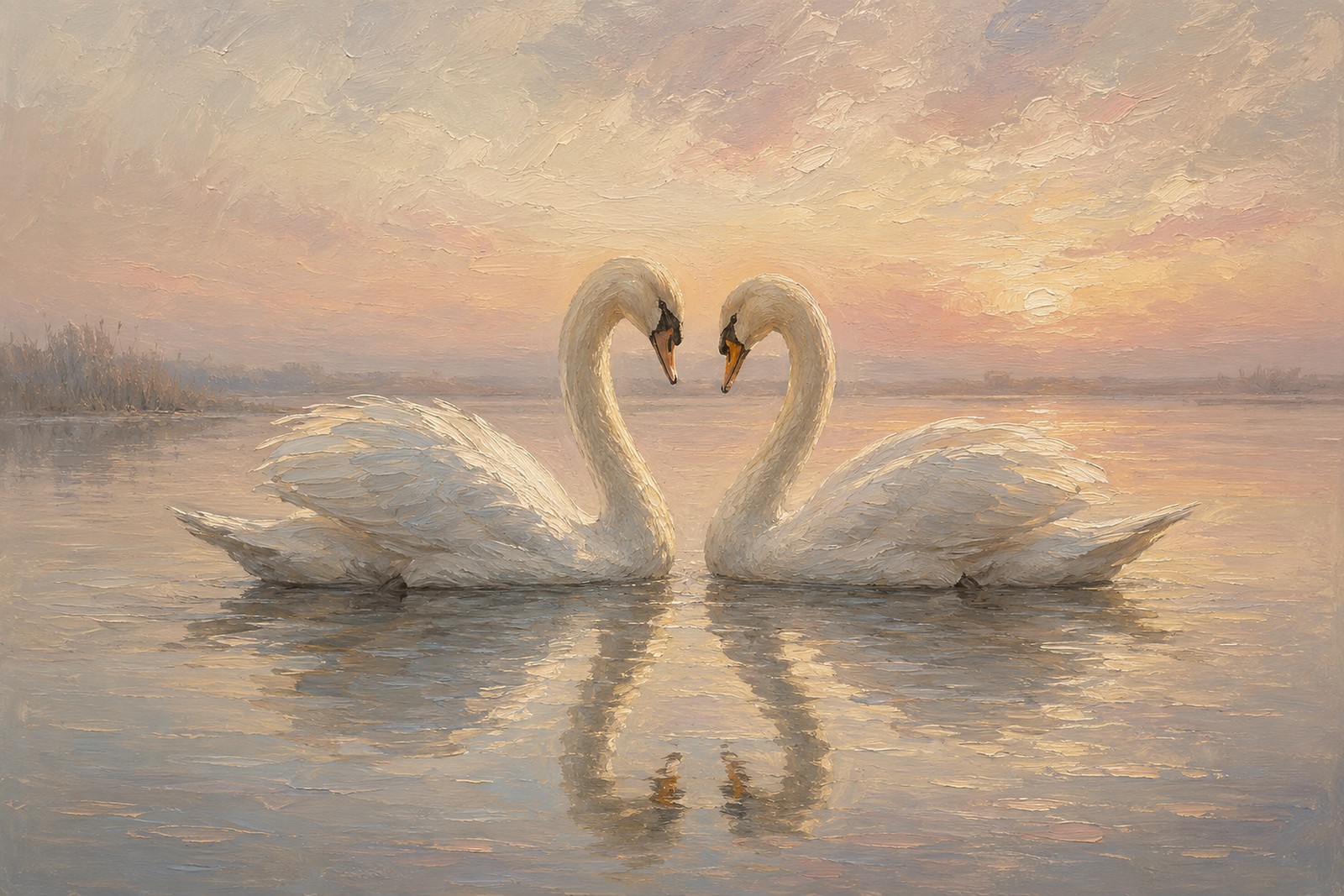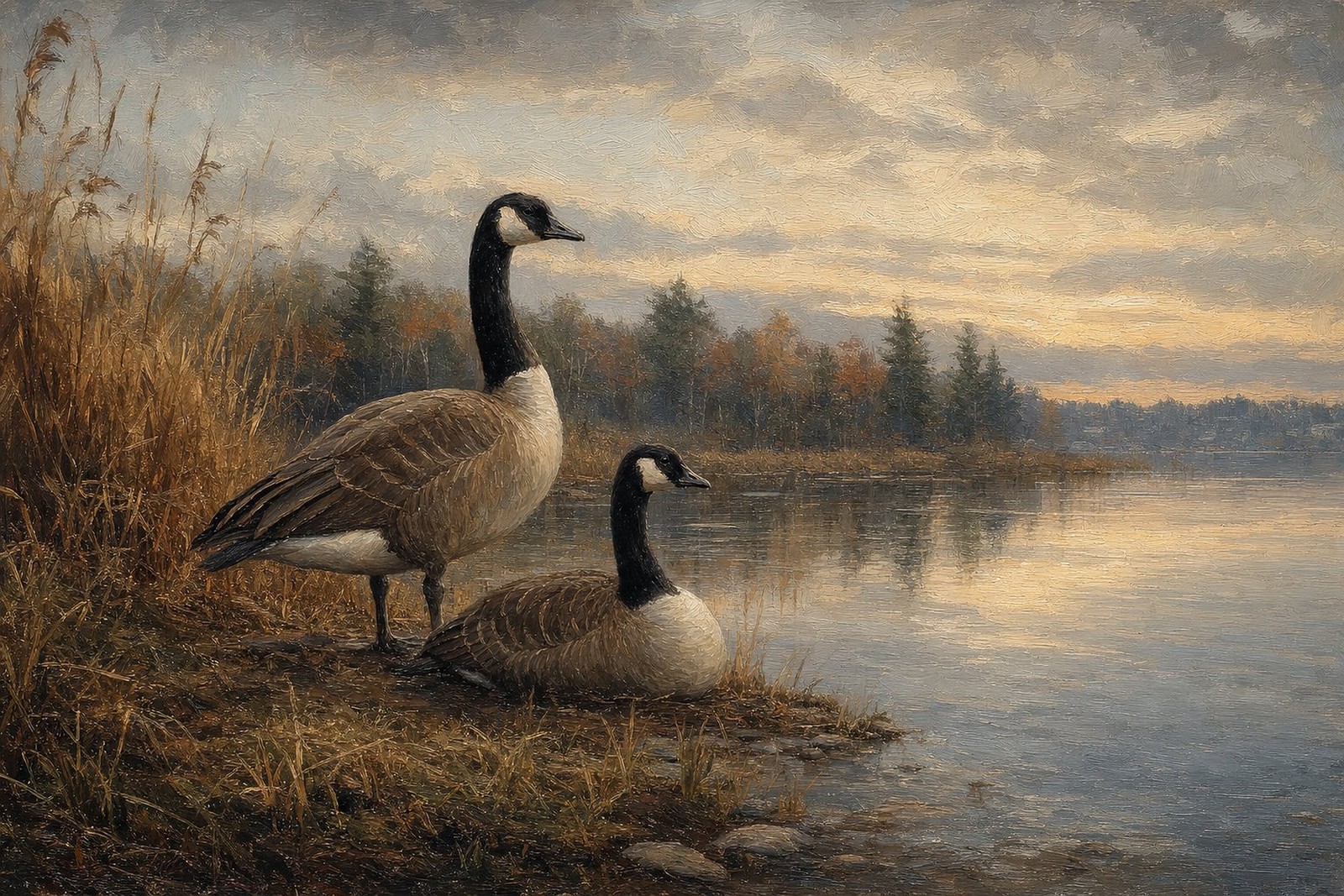
Some birds you need a field guide to name. The Canada goose is not one of them. The black neck, the white chinstrap, the long V dragging autumn south behind it: this is the most recognisable silhouette in American skies, known to every person who has ever stood in a parking lot in October and looked up. That recognition is precisely what makes it the migration classic on a wall. A Canada goose print never needs explaining. It reads instantly, from across the room, and it reads the same way to everyone.
Why the Canada goose is the classic
Familiarity usually works against a subject in wall art. Nobody wants a print of something they scroll past. The Canada goose escapes that trap because familiarity with the bird is not the same as being tired of it. Most of us see Canada geese at their least impressive, grazing a soccer field or holding up traffic at a business park. The bird in art is the other one: the long-distance flier crossing a cold sky, or the pair standing composed at the edge of a grey lake at first light.
There is also the matter of scale. A Canada goose is a genuinely big bird, and the giant subspecies, the largest goose in the world, can carry a wingspan approaching six feet. We cover that bird properly in our guide to the giant Canada goose, but the short version matters for decor: this is a subject with real presence, and a print of one carries that presence onto the wall. The high-contrast head pattern does the graphic work. That white chinstrap against the black neck is one of nature’s most legible marks, and it anchors a composition the way a signature anchors a letter.
A calm pair or a flight scene?
Canada goose art divides into two classic compositions, and choosing between them is mostly a question of what you want the room to feel like.
The pair. Two geese at the water’s edge, close together, heads up, the lake flat behind them. This is the grounded, domestic version of the bird, and it earns its calm honestly: Canada geese form famously durable pair bonds, often keeping one mate for life, a story we tell in full in our post on goose mating season. A pair composition suits the rooms where people sit still: living rooms, bedrooms, the wall facing a reading chair. It has the same quality a good heron print has, composure rather than action.
The flight scene. A skein crossing the sky, necks stretched, the landscape falling away below. This is the version with direction and weather in it, and it suits rooms people move through: entries, hallways, stair walls, offices. A flight composition gives a wall a vector, and the eye follows it every time you pass.
Both compositions, along with autumn marsh scenes and winter flock studies, sit in our geese and migration collection, which is built around this bird and its relatives for exactly the reasons above.
Where Canada goose art belongs
The lodge and the lake house. This is the bird’s natural decorating habitat. Timber walls, leather, plaid, a stone fireplace: goose art in the style of classic American sporting art has hung in rooms like this for over a century, and it still looks like it grew there. A brown frame leans into the tradition.
The office and the study. Migration is the most disciplined thing birds do, and something of that reads through the art. A Canada goose print above a desk carries purpose without slogans, and the muted palette, umber, slate, and cream, sits comfortably against bookshelves and dark wood.
The entry hall. First impressions favour instantly legible art. Guests recognise the bird before they have taken their coat off, and the outdoor subject sets the tone of the house without tipping into theme decorating.
The family room and the cabin bunk room. Because everyone knows this bird, it works in shared spaces where the art has to please a crowd. It is wildlife art without a whiff of the gallery about it.
The palette is quieter than you expect
A Canada goose print is, in colour terms, a study in warm neutrals. Browns from tan to dark umber, a slate-black neck, a cream chest, marsh golds and grey-blues in the water and sky. There is no loud accent colour to fight the room. That makes these prints unusually easy to place: they sit well against warm white walls, olive and deep green, navy, and nearly every wood tone. If the room already holds leather, walnut, or brass, the print will look like it was chosen by someone who planned the whole space at once.
Wall colour advice, briefly. Warm white or oat keeps things airy and lets the dark neck carry the contrast. Deep green or navy turns the print formal and makes the cream chest glow. Grey walls want the brown frame rather than black, or the whole scheme cools down too far.
What size should a Canada goose print be?
All our prints are landscape format in a 3:2 ratio, printed edge to edge with no mats, in three sizes.
12x18. The shelf and small-wall size. It works propped on a mantel or picture ledge, hung in a kitchen nook, or run in a series of three down a hallway.
16x24. The default. Right over a console table, between windows, or above a desk. Big enough to read from across the room, small enough to hang almost anywhere.
20x30. The anchor. Over a sofa, a bed, or a mantel, follow the two-thirds rule: art should span roughly two-thirds the width of the furniture beneath it, and 20x30 gets there for most sofas when hung solo with eight to ten inches of breathing room above the furniture line.
Migration scenes in particular want width. The landscape format is not incidental; a V of geese needs sky to cross, and the 3:2 ratio gives the composition room to move.
The honest details
Every print in the collection is an original AI-created artwork in the style of antique oil painting. We say that plainly because we think buyers deserve to know exactly what they are hanging: not a photograph, not a reproduction of a historical piece, but new oil-painting-style art made for this catalogue. Each one is printed to order and dispatched within 2 to 5 business days. Unframed prints are $59, $89, and $119 for the three sizes; framed prints, in black, brown, or gold, are $189, $259, and $329; a digital download is $19. Shipping is free to the US, Canada, the UK, Europe, Australia and New Zealand, and every order carries a 30-day replacement or refund guarantee if it arrives damaged, defective, or wrong.
Frequently asked questions
What frame colour suits a Canada goose print?
Brown is the traditionalist’s answer, echoing the bird’s own umber tones and the lodge rooms this style of art descends from. Black is the modern answer, sharpening the contrast the chinstrap already provides. Gold suits rooms that lean formal or grandmillennial, picking up the marsh golds in the background.
Is this a photograph or a real oil painting?
Neither. It is an original AI-created artwork rendered in the style of antique oil painting, and we describe it that way everywhere it is sold. The layered, traditional look is the point, but so is being straight about how it was made.
What size works over a sofa?
20x30 for a standard three-seat sofa, hung so the print spans about two-thirds of the sofa’s width. Over a loveseat or a wide reading chair, 16x24 does the same job at the smaller scale.
Do the prints come with a mat?
No. Every print runs edge to edge in a 3:2 landscape ratio, with no mat, and the framed versions are built for that full-bleed look. If you want visual breathing room, the wall itself does that job better than a mat would.