A lake house argues with its own walls. Every room is arranged around the window, the water does most of the decorating for eight months of the year, and anything you hang has to hold its own against that view without trying to beat it. That is a different brief from decorating a city living room, and it explains why so many otherwise well-loved lake houses end up with a routed “LAKE RULES” sign and a crossed pair of paddles over the sofa. Novelty is the path of least resistance.
The better path is to hang art that comes from the same world as the window: water, reeds, birds, first light, rendered in the style of classic American sporting art and sized correctly for the wall it lives on. This guide works through the house room by room, then covers the scale rules, the palette, and which birds belong where.
What makes lake house wall art different
Three things, and they change every decision that follows.
The light. Lake rooms are brighter than almost any other domestic space, with big glazing and glare bouncing off the water. Pale, minimal prints wash out in that light. Art with deep, warm ground tones, umber, bottle green, dawn gold, holds its colour at noon and gets richer in the evening.
The walls themselves. Knotty pine, cedar, shiplap, and log are busy surfaces. A print with a faint composition disappears into the grain. What survives is a strong central subject with a clear frame edge around it, which is why an oil-painting-style print in a proper frame reads so well against timber where a frameless canvas goes missing.
The view. You are competing with actual water. Abstract art changes the subject and loses. Wall art works in a lake house when it continues the landscape rather than interrupting it, the same marsh, the same birds, the same hour of the morning, held still.
The great room: one wall, one anchor
The classic great room mistake is a scatter of small pieces that reads as clutter from across an open plan. Big room, big sightlines, one big statement.
Pick the largest wall that does not face a window head-on, usually behind the sofa or above the fireplace, and give it a single 20x30 print, framed. At two and a half feet wide before the frame, that is the size that still reads from the kitchen island at the other end of the room. A framed piece at $329 is the most expensive single decision in this guide, and it is also the one that does the most work, because every guest sightline in the house ends on that wall.
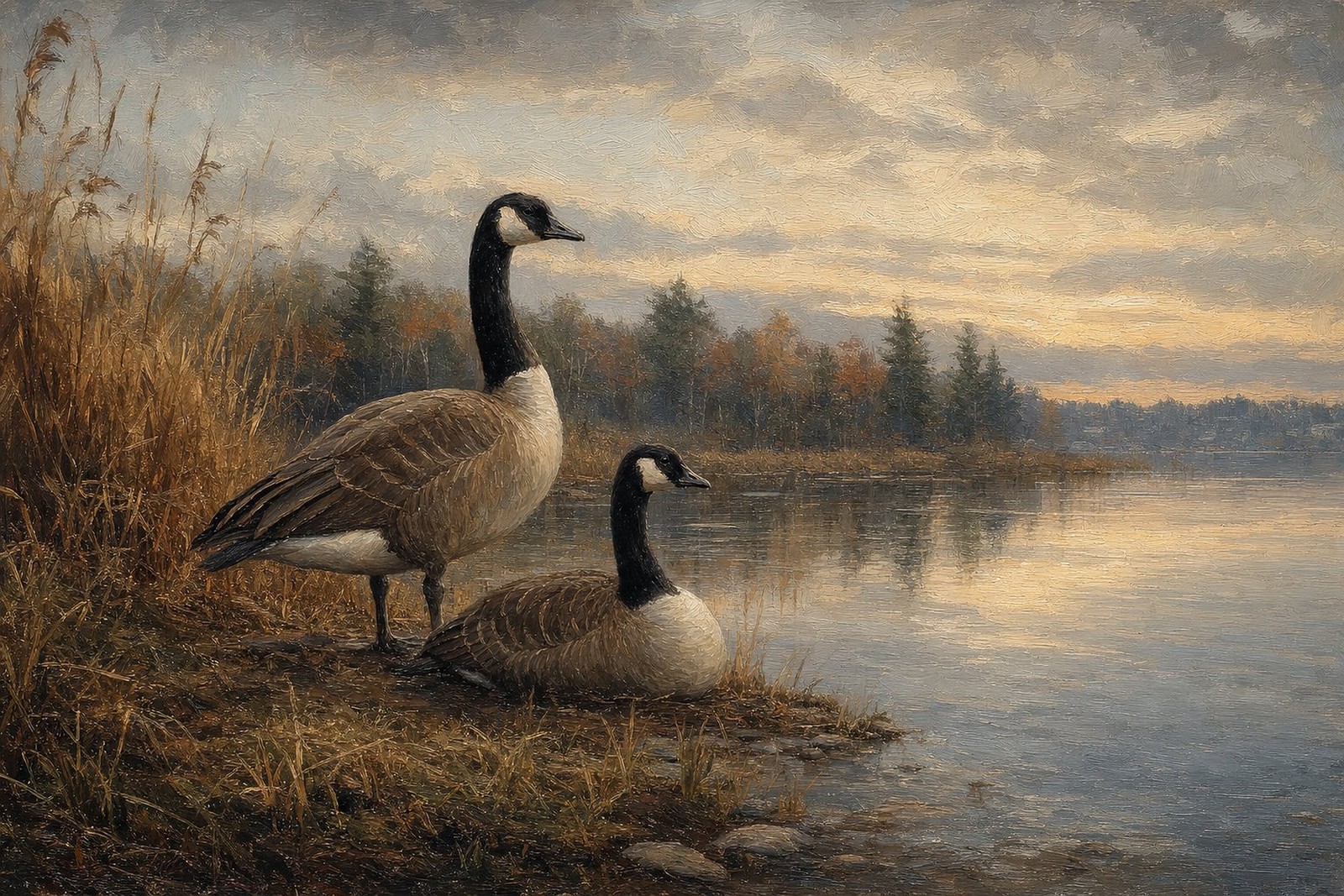
This is where the sporting classic belongs. Old Decoy and Mallards at Dawn puts the heritage of the whole genre in one image, a working decoy in the foreground and live birds over the water behind it. Geese read just as well at great-room scale: Canada Geese Over Autumn Marsh or Morning Honkers Over Timberline both carry the kind of sky that suits a tall gable wall. If your great room runs dark rather than bright, stone, heavy timber, low lamplight, the darker end of this palette is covered properly in our hunting lodge wall art guide.
In an A-frame or a room with high gables, resist the urge to chase the peak. Keep the print at normal eye height, centred about 60 inches from the floor, and let the wall above stay empty. The emptiness is what makes the piece look placed rather than lost.
The bunk room: small prints, big morale
Bunk rooms take the opposite approach: small, warm, and a little bit narrative. A 12x18 print at $59 unframed is the right scale for the strip of wall beside a bunk or above a dresser, and at that price you can give each wall its own bird without treating it as a capital project.
Family scenes work hardest here. Common Loon Pair with Chick, Canada Goose Family with Goslings, and Northern Bobwhite Family Covey are all compositions built around adults and young, which lands differently in the room where the kids sleep. Wood Ducks in Misty Creek does the same job with more colour. One print per wall beats a crowded arrangement in a room that is already busy with beds.
The screened porch and the entry
A screened or covered porch can take art as long as the wall is genuinely dry, meaning under the roofline and out of the reach of wind-driven rain. Choose the sheltered wall next to the house door rather than the outer edge, and accept that porch art lives a harder life than indoor art.
The entry is a better investment and the most underused wall in most lake houses. A single 12x18 above the boot bench sets the tone for everything past the door, and there is one print in the catalogue that was practically drawn for the job: Belted Kingfisher on Weathered Dock Post, the bird every lake owner already knows from their own dock, sitting exactly where it sits in life.
The stairwell: the wall everyone forgets
Stairwells punish improvisation, and they reward one simple system: a stepped run of matching prints. Take three 12x18 prints in the same frame finish, hang them so each centre sits roughly 60 inches above the tread below it, and let the line of frames climb with the stair at the same pitch as the handrail.
Because every print in the range shares the same 3:2 landscape format, printed edge to edge with no mat, a stepped run automatically reads as a set even when the subjects differ. Three water scenes in the same tones, a teal, a wigeon pair, a quiet stretch of marsh, make the climb feel composed without a single measurement beyond the 60-inch rule.
How big should lake house wall art be?
The scale rules are short, and they solve most of the decisions in this guide:
- Two-thirds rule. Art above furniture should span roughly two-thirds the width of the piece below it, a sofa, a bed, a console, a mantel. Undersized art is the single most common reason a finished room still looks provisional.
- 20x30 is the statement size, for the great room anchor, above a king bed, or over a wide mantel. $119 unframed, $329 framed.
- 16x24 is the workhorse, right for dens, bedrooms, dining walls, and above most dressers. $89 unframed, $259 framed.
- 12x18 is for entries, bunk walls, stairwell runs, and any print that hangs as part of a group. $59 unframed, $189 framed.
Frames come in black, brown, or gold. Brown is the default against pine and cedar because it stays in the same wood family. Black suits the newer white-walled lake house, where the frame provides the contrast the walls refuse to. Gold belongs where the house leans traditional, plaid throws, brass lamps, a stone chimney.
A palette pulled from the water
Take the colour cues from the lake at six in the morning, not from a paint chart. Dawn gold, reed umber, slate blue, and bottle green are the four notes that almost every print in this style is built from, and they are also the colours a lake actually produces, which is why the art never argues with the window.
Those tones sit naturally with the textiles lake houses already own: navy, buffalo check, faded canvas, worn leather. If the room has a dominant colour already, choose prints where that colour appears in the water or the sky rather than on the bird itself, and the wall will tie the room together without matching anything too literally.
Which birds belong on a lake house wall?
Every lake house has its own cast, but six subjects carry the genre:
The loon. The sound of the northern lake made visible. Common Loon on Northern Lake for the purist, Loon Calling Across Misty Water for anyone who has heard that call through a bedroom screen at midnight.
The old decoy. The single most lake-house image in the whole collection, sporting heritage framed honestly as style.
The heron. The most composed bird on the water, and the one that turns a wall formal. Our full heron print guide covers where it works best.
The kingfisher. The dock’s resident. Best at 12x18 in an entry or a hallway.
Red-winged blackbirds. The sound of the cattail shore in late spring, and the most colour this palette allows itself.
Geese in autumn. The calendar birds, the ones that mark closing weekend. Best big, where the sky matters.
All of these live in our Lake House & Lodge print collection and its neighbouring collections in the print room, every one an original AI-created artwork in the style of antique oil painting, printed edge to edge in 3:2 landscape.
Ordering, in practice
Every print is made to order and dispatched in 2 to 5 business days, with free shipping to the US, Canada, the UK, Europe, Australia, and New Zealand. Unframed prints run $59, $89, and $119 across the three sizes; framed, $189, $259, and $329. There is also a $19 digital download of any artwork if you would rather print and frame locally. If an order arrives damaged, defective, or not what you ordered, there is a 30-day replacement or refund.
Frequently asked questions
What size wall art does a lake house great room need?
Almost always the largest available. A 20x30 print, framed, is the minimum size that reads across an open-plan great room, and it should hang on the biggest wall that does not directly face a window, sized to roughly two-thirds the width of the furniture beneath it.
Should lake house art be framed or unframed?
Framed on timber walls, because the frame edge is what separates the art from the grain of the pine or cedar behind it. Unframed makes sense in bunk rooms and utility spaces where budgets go further, or when you already have frames you like. Brown frames suit wood-heavy houses; black suits white-walled modern builds.
How do I hang prints in a lake house stairwell?
Use a stepped run of three matching 12x18 landscape prints, each centred about 60 inches above the tread below it, so the line of frames climbs at the same angle as the handrail. Matching sizes and frame finishes matter more than matching subjects.
What style of art suits a lake house best?
Art that continues the view rather than competing with it: wetland and waterfowl subjects in deep, warm tones. Oil-painting-style prints hold up in bright lakefront light and sit naturally against wood walls, which is why the style has been the default for lake and lodge interiors for generations.