Ask someone to draw a duck and they will draw a mallard. The deep green head, the white collar, the chestnut breast: this is the duck from the park pond and the childhood picture book, the bird that taught most Americans what a duck looks like in the first place. That familiarity is precisely why mallard wall art has hung in dens, offices and cabins for the better part of a century, and why it keeps earning the space. A mallard print needs no explanation. It reads instantly, from across the room, to everyone who walks in.
This guide covers why the mallard became the default American duck print, what the drake’s colours actually do for a room, and how to hang one well, whether that means a single drake behind a desk or a facing pair over a cabin sofa.
Why is the mallard the default American duck print?
Part of it is sheer presence. The mallard is the most abundant duck in North America, breeding across all of the lower 48 states and turning up on everything from prairie potholes to golf course water hazards. It is also the wild ancestor of nearly every domestic duck breed, which makes its shape, quite literally, the template for what a duck is.
The decorating tradition has deeper roots than familiarity, though. When the United States created the federal duck stamp in 1934 to fund wetland conservation, the first stamp, designed by the cartoonist and conservationist J.N. “Ding” Darling, showed a pair of mallards dropping into a marsh pond. American sporting art held the same line for the next hundred years: when a calendar, a magazine cover or a lodge wall needed one duck, it got a mallard. Hang one today and the room joins that lineage without a word being said.
There is a practical point too. Guests recognise it. A goldeneye print rewards the person who knows ducks. A mallard print works on everyone, which is exactly what you want from the most visible wall in a den or an office.
What do the drake’s colours do for a room?
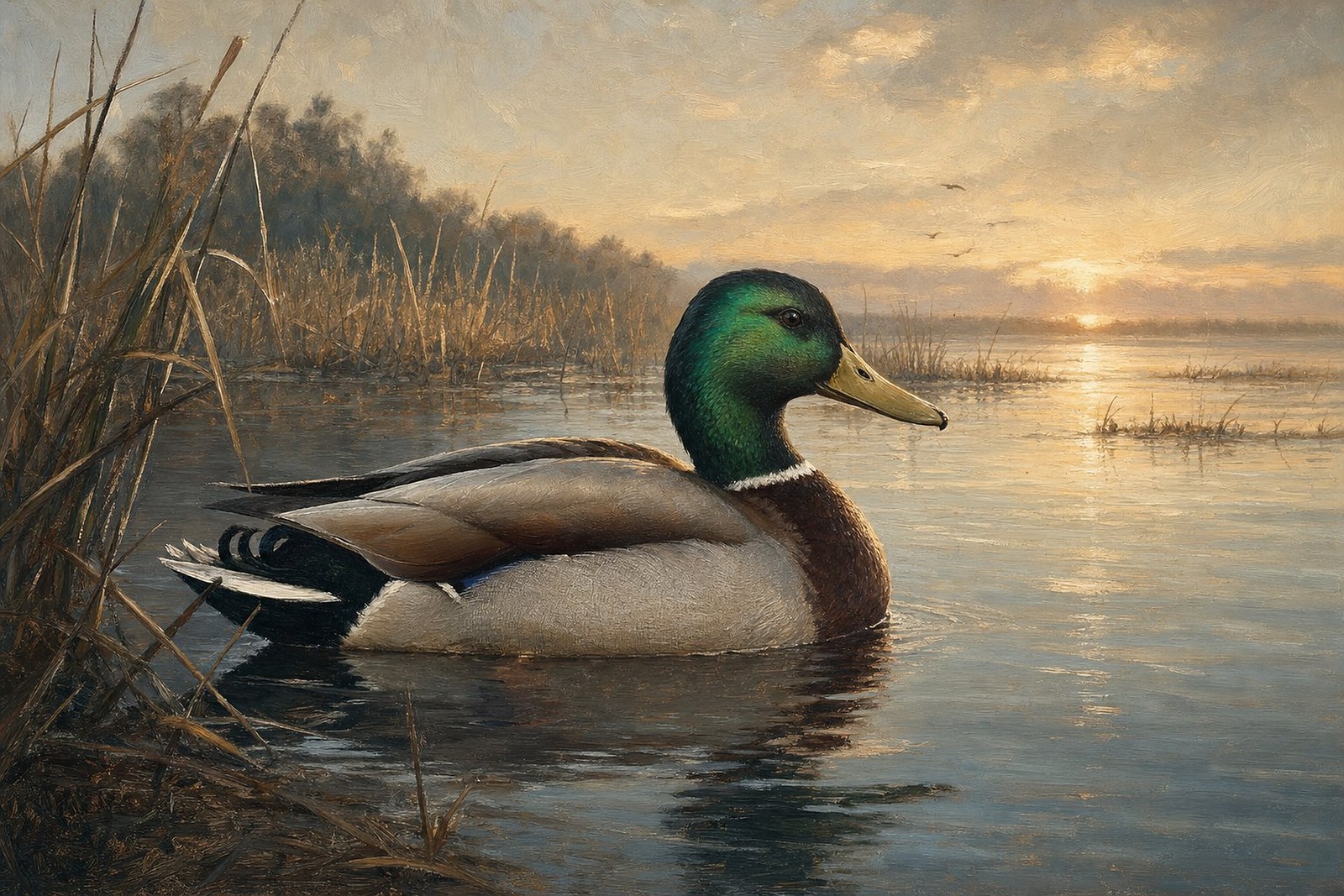
The mallard drake carries one of the most useful palettes in wildlife art. The head is a bottle green so deep it reads nearly black in low light. Below the crisp white neck ring sits a chestnut breast, then soft grey flanks and the small black curl of tail feathers that marks a drake. He is the most famous of the ducks with green heads, and the reason that green and chestnut pairing now feels like visual shorthand for the outdoors.
Translate that into decorating terms and you get forest green, oxblood, warm tan and slate: the standing palette of dens, libraries and cabins. A mallard print repeats colours the room already holds in its leather, timber, plaid and brass, which is why it settles onto those walls so quickly. Rendered in antique oil-painting style, the plumage mutes further into heritage tones, so the print reads as something the room has always had rather than something bought last month.
The rooms a mallard print anchors
The den. This is the mallard’s natural indoor habitat. A 16x24 above a leather reading chair or between bookcases gives the room a centre of gravity, and the drake’s palette ties the wall to whatever leather and wood are already doing below it. If the den has a full sofa wall, step up to the 20x30.
The office. A duck print is one of the few pieces of wildlife art that survives a professional setting, because sporting art has a long history in banks, law offices and studies. It reads as credible rather than cute, and behind a desk at head height it does quiet work on every video call.
The cabin and the lake house. Here the mallard belongs by right. This is a bird of the pond and pothole country, and a print of one over the sofa or the bunk room dresser connects the wall to the water outside the window.
Entries and landings. The wide landscape format sits naturally above a console table or a bench, the two most common entry arrangements in traditional homes, and the subject sets a tone of calm before anyone reaches the main rooms.
Our mallard drake at dawn
Our mallard print shows a drake low on still water at first light, reeds soft behind him, the sky just beginning to colour. It is an original AI-created image in the style of classic American sporting art, composed as a 3:2 landscape and printed edge to edge, with no mats and no borders, so the water runs the full width of the sheet.
It comes in three sizes: 12x18 at $59, 16x24 at $89 and 20x30 at $119 unframed. Framed in black, brown or gold, the same sizes are $189, $259 and $329, and a digital download is $19. Every print is made to order and dispatched in 2 to 5 business days, with free shipping to the US, Canada, the UK, Europe, Australia and New Zealand.
On frame colour: brown sits closest to leather and timber and is the safe den choice. Black is the cleanest match for an office. Gold leans formal and looks right over a mantel or beside older furniture.
Does a mallard print work as a pair?
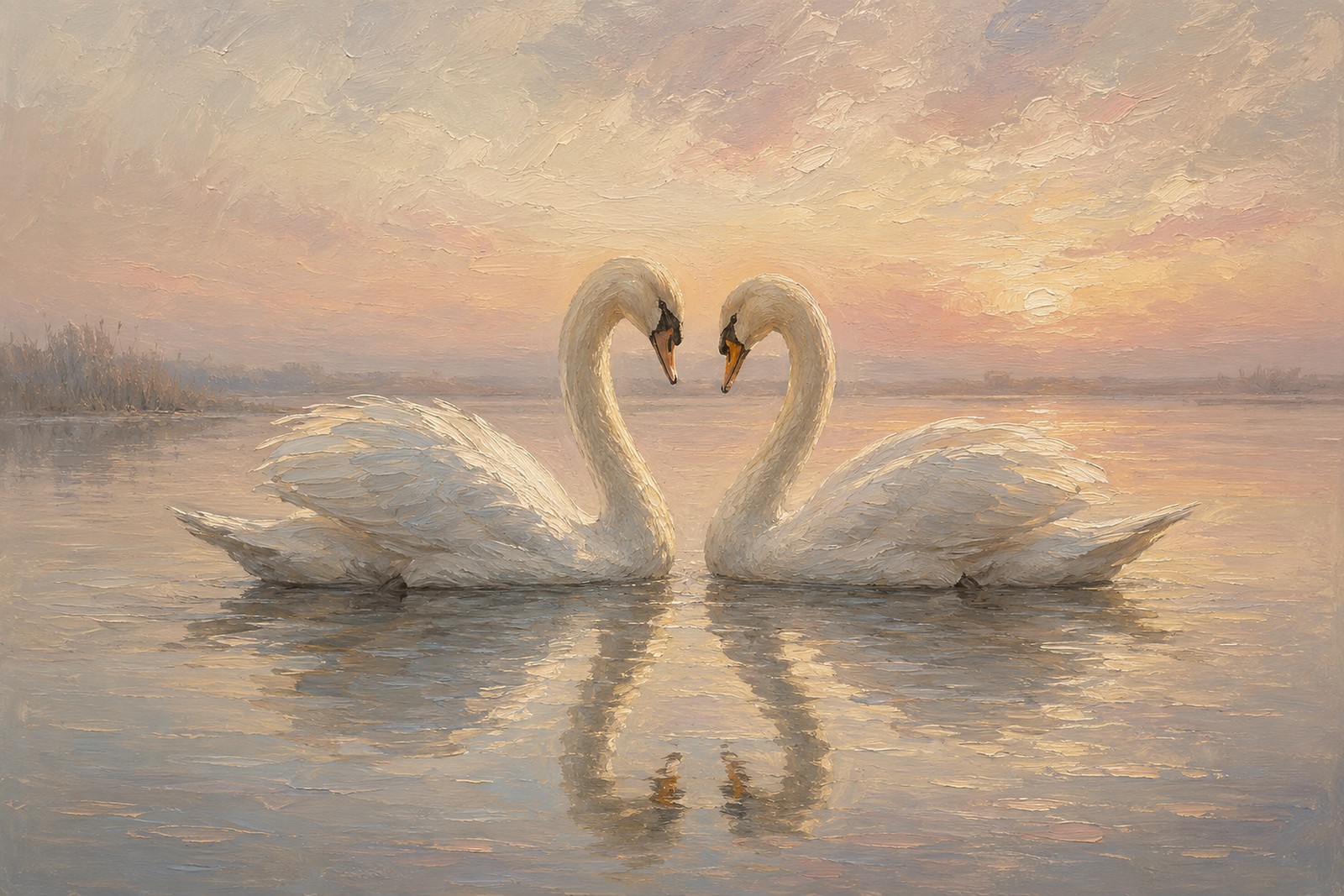
Better than almost any other subject. Traditional decorators have worked to the same symmetry rule for centuries: paired art should face inward, toward the centre of the arrangement, so the two pieces close the composition instead of leading the eye off the wall. A drake print on one side and a companion composition angled back toward it on the other, hung at matching heights over a console, a sideboard or a bed, is among the most reliable formal arrangements in decorating.
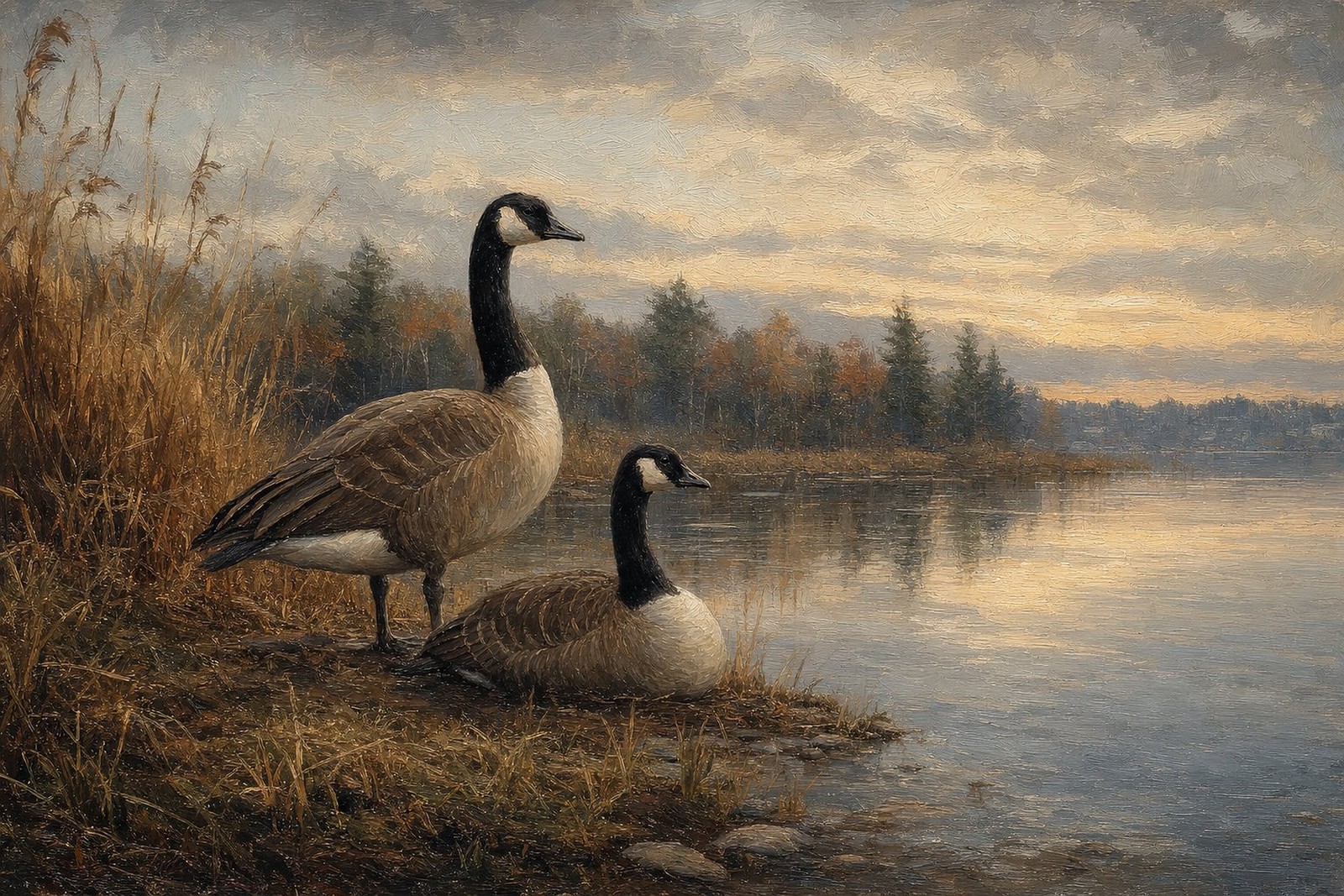
The mallard is the anchor species of the full waterfowl and marsh birds collection, and its companion piece, a mallard pair in morning reeds, was composed for exactly this use: the same dawn light, the same still water, the birds angled to face back across the wall. One print anchors a room. The facing pair frames it.
How big should mallard wall art be?
Work from the furniture, not the wall. Above a desk or a reading chair, the 16x24 is right: substantial without looming. Above a sofa, go to the 20x30, or hang two prints side by side to span roughly two thirds of the sofa’s width. In a hallway or on the short wall at the end of a landing, the 12x18 carries further than its size suggests, because the low horizon in the composition gives the wall depth.
Hang so the centre of the print sits 57 to 60 inches from the floor, standard gallery eye level, and keep 6 to 10 inches of air between the bottom of the frame and the furniture below it.
Frequently asked questions
Is the mallard print a real oil painting?
No, and we say so plainly. It is an original AI-created image in antique oil-painting style, in the tradition of classic American sporting art, printed to order on archival paper. It is not a photograph and not a reproduction of a historical work, and we never describe it as either.
What size mallard print suits an office?
The 16x24 is the working answer for most offices: large enough to read on a video call, small enough to hang behind a desk without crowding shelving. If it will hang alone on a large blank wall, take the 20x30.
Which frame colour works best in a den?
Brown, in most cases. It picks up leather, timber and brass and keeps the whole wall in one temperature. Choose black if the den runs modern, and gold if the furniture is older and more formal.
What happens if my print arrives damaged?
You get a free replacement or a refund within 30 days for anything that arrives damaged, defective or wrong. Because every print is made to order, we do not take change-of-mind returns, so it is worth measuring the wall and checking sizes before you order.