Coastal art has a daylight problem. Walk through any print shop’s coastal section and it is permanently ten in the morning: bright water, white light, blue sky. Which is fine, until you try to hang that art in the rooms where people actually spend their evenings. A sunlit seascape in a dim study looks like a television left on standby.
The coast has a second palette, the one that arrives at dusk, and it has a bird to go with it. The black-crowned night heron is the after-hours member of the heron family, and a night heron print is the rare piece of coastal art that gets better as the light goes down. This guide covers the bird, the problem it solves, and the rooms it was practically designed for.
The bird that works the night shift
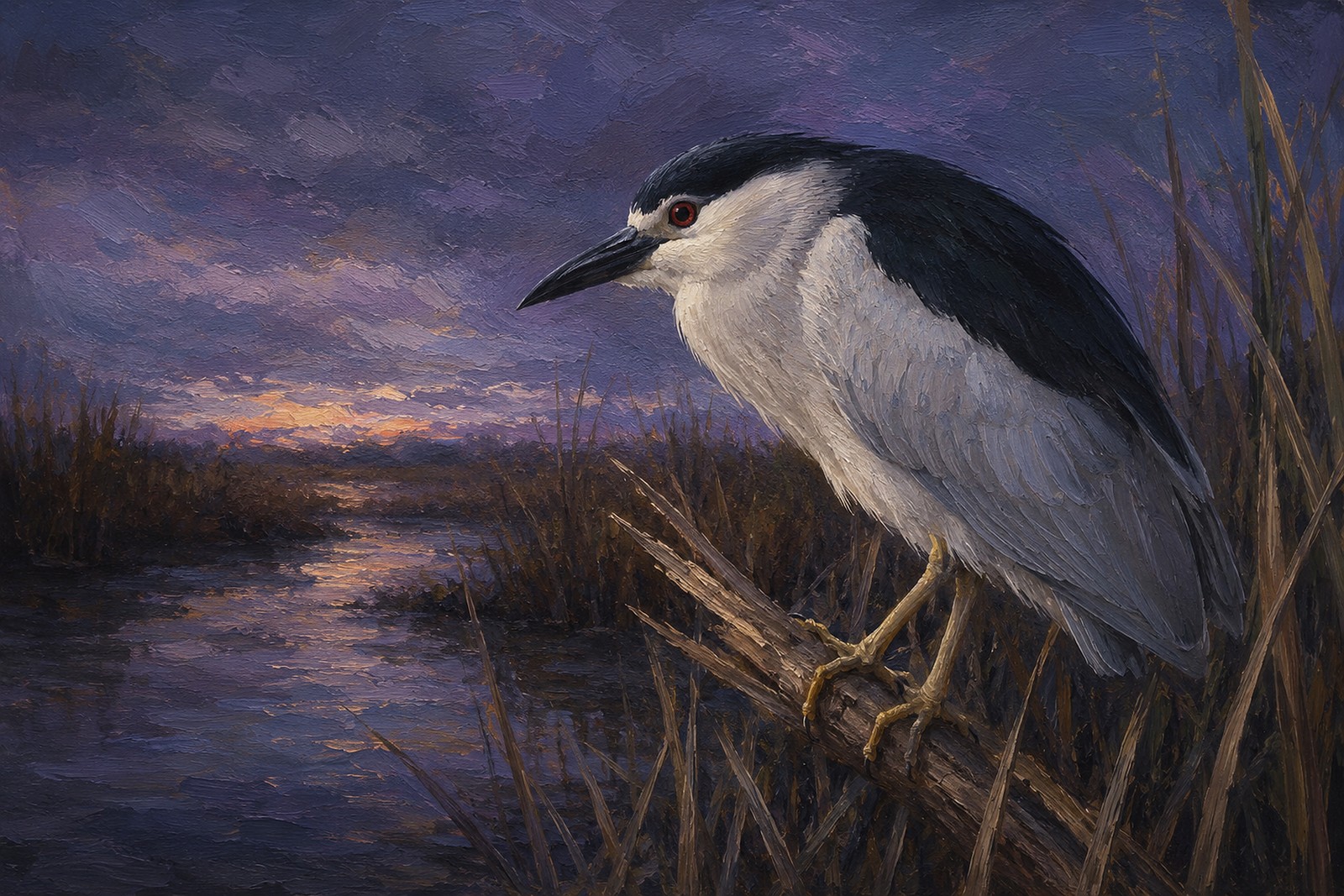
Everything about the black-crowned night heron announces a different shift from its tall, daylight-hunting cousins. It is stocky where the Great Blue Heron is elegant, compact and thick-necked, with a black cap and back over pale grey, and a deep red eye built for gathering the last light. Through the day it roosts hunched in waterside trees, looking faintly disapproving. At dusk it clocks in, flying out to harbour pilings, marsh edges and tide lines to hunt through the evening and into the dark, announcing itself with a hollow barking call that carries across the water.
It is also one of the most widespread herons on earth, working night shifts on coastlines and wetlands across the Americas, Europe, Africa and Asia. If you have ever heard a short, gruff quok overhead at dusk near the water, you have probably met one.
Where the Great Blue reads as poise, the night heron reads as intent. Hunched, patient, slightly saturnine. That character is exactly what makes it the moody pick.
What is the moody corner problem?
Every house has one: the corner, hall or alcove that never gets decent light. The den with one north window. The wall behind the reading chair. The short corridor to the bedrooms. Most people try to fix these spots with bright art, on the theory that a sunny image will cheer the place up, and it always fails the same way. Without light to feed on, bright art goes flat and grey, like a postcard pinned to a wall.
Dark art works the opposite way. A print built on a dusk palette, slate blues, green-black water, the last amber of the afternoon going out along the horizon, meets a dim room on its own terms. It is not waiting for daylight that never comes; the gloom is in the picture already, and the picture organises it. Under a single warm lamp, a dusk-palette print does something bright art cannot: the shadows in the image deepen, the amber picks up the lamplight, and the corner stops feeling under-lit and starts feeling deliberate.
Our night heron print was composed for exactly this use. The bird stands at the water’s edge as the light fails, and the whole scene runs on blues and golds pitched for rooms that live in lamplight.
Studies, bars and the rooms after dark
Some rooms are dim by accident. Others are dim on purpose, and those are where the night heron print earns its keep.
The study. Dark joinery, a desk lamp, evening use. A dusk print above the desk or the shelves holds its depth in exactly the light a study actually has, and the bird’s watchful patience suits a room built for concentration.
The home bar. Bar corners run on low, warm, flattering light, which is the precise condition this palette wants. Hang it behind the bottles or beside the shelf glow and the print reads like the view from a waterfront tavern window.
Dens and media rooms. Rooms designed around screens keep their walls deliberately dark. A moody coastal print gives those walls something to say without fighting the room’s job.
Reading corners and halls. Anywhere a lamp is the main event, the dusk palette cooperates.
The materials these rooms favour, leather, walnut, brass, smoked glass, all flatter the print’s palette. If the whole room leans this direction, our hunting lodge wall art guide covers the wider family of dark, traditional wildlife art these spaces are built around. And if you are weighing the moody pick against the classic daylight option, the Great Blue Heron guide makes the case for the formal end of the family; the two birds solve different rooms.
Which frame suits a dusk palette?
Framed night heron prints come in black, brown or gold at $189, $259 and $329 across the three sizes, and the choice matters more here than with brighter art.
Gold is the counterintuitive winner, especially on a dark wall. A slim gold frame around a dusk scene glows under lamplight and gives the piece the finish of the old club and lodge pictures its style descends from. On navy, forest green or charcoal walls, gold is the pick.
Black is the tonal choice. It extends the print’s own darkness to the wall and reads clean and modern, best where the room’s fittings are already black or the scheme is contemporary.
Brown bridges the print to wood: walnut desks, oak shelves, leather chairs. It is the quiet option and it never clashes.
Unframed, the print is $59 at 12x18, $89 at 16x24 and $119 at 20x30, all 3:2 landscape, printed edge to edge on archival fine-art paper so the dark water runs clean to the frame line with no white border to break the mood. A digital download is $19.
Like every piece in our heron and egret prints, it is an original AI-created artwork in the style of antique oil painting, stated plainly on the product page. The deep, layered rendering is what lets the dark tones hold detail instead of collapsing into murk, which is the failure mode of cheap dark posters.
Everything is made to order and dispatched in 2 to 5 business days, with free shipping to the US, Canada, the UK, Europe, Australia and New Zealand, and a 30-day replacement or refund policy for anything that arrives damaged, defective or wrong.
Frequently asked questions
What exactly is a night heron?
A true heron, just a nocturnal one. The black-crowned night heron is a stocky, short-necked member of the heron family with a black cap and back, grey wings and a red eye, found on coasts and wetlands across most of the world. It roosts by day and hunts from dusk through the night, which is where the name and the character come from.
Does dark art make a small room feel darker?
Used as a wall colour, dark tones can shrink a room. Used in one framed print, they do the opposite: the dark image gives a dim room a focal point that actually suits its light level, and under a lamp it adds depth rather than gloom. The mistake is pairing dark art with harsh overhead light, which flattens it. Lamplight is the natural condition for this palette.
Which frame colour works best on a dark wall?
Gold, in most rooms. Against navy, green or charcoal walls, a slim gold frame catches lamplight and lifts the print away from the wall without breaking the moody scheme. Black frames on dark walls read sleek but can merge into the wall; brown sits between the two and suits wood-heavy rooms.
Is the night heron print a photograph taken at dusk?
No. It is an original AI-created artwork in the style of antique oil painting, printed edge to edge on archival fine-art paper in a 3:2 landscape format. We describe it that way on the product page because the rendering, not a camera, is what gives the scene its held, deliberate dusk.