Every beach town in America sells the same pelican: a cartoon bird in sunglasses, usually holding a sign that says something about flip flops. It is the mascot version of a genuinely remarkable animal, and it has done real damage to the pelican’s reputation as wall art. Plenty of Gulf and Atlantic homeowners who love watching the real bird glide past their deck would never hang one indoors, because the only pelican art they have seen belongs on a souvenir stand.
That is a shame, because the brown pelican, treated seriously, is one of the strongest subjects in coastal art. This guide makes the case for pelican wall art done properly, and covers where it works in a beach house and how to size it.
Why does the brown pelican beat the cartoon pelican?
Because character outlasts jokes. Novelty decor works exactly once, the first time a guest reads the sign, and then it spends years being furniture-adjacent clutter. A bird with real presence keeps working every time the light changes.
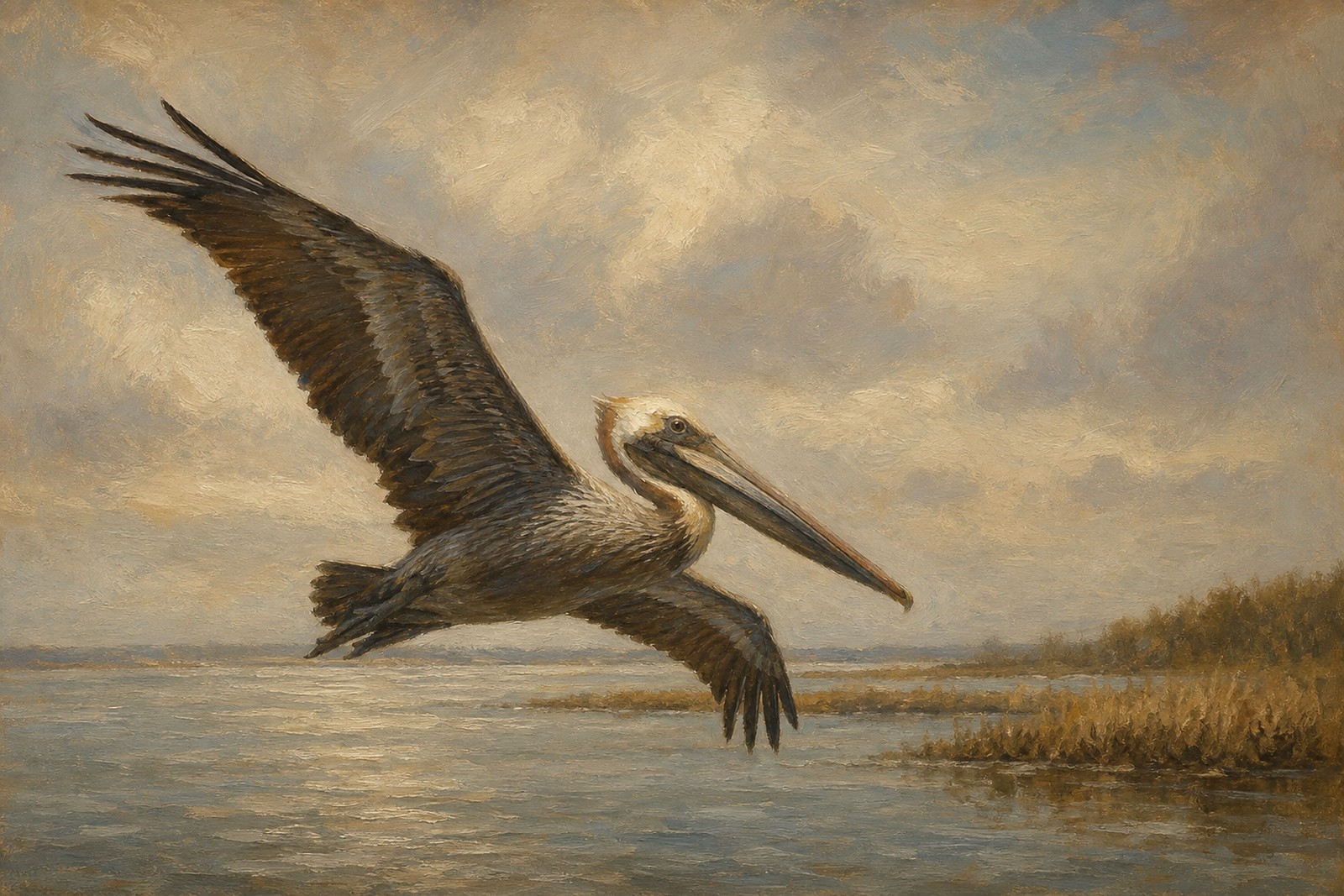
And the brown pelican has presence to spare. This is a heavy, unhurried, precise animal with a wingspan over six feet, and almost everything it does looks deliberate. Watch a line of them travel along a shoreline: single file, wingtips nearly brushing the swells, riding the cushion of air above the water without a single flap for a hundred yards. Then watch one hunt, climbing, folding itself into a spear, and hitting the water like a thrown axe. Comedy on the dock, gravity in the air. That combination is what art can capture and a cartoon cannot.
Rendered in the style of classic American sporting art, the pelican stops being a mascot and becomes what it actually is: a big, dignified seabird that has patrolled these coasts since long before the gift shops arrived.
A bird with a story worth hanging
The brown pelican earns its place in a serious home on biography alone. It is the state bird of Louisiana, the bird on the state flag, and one of the great American conservation comebacks: pesticide-era eggshell thinning nearly wiped it from the Gulf coast within living memory, and its recovery after the DDT ban brought it all the way back to the noisy, thriving colonies you see today. Along Florida’s south coast, pelicans roost in the tangled edges of the mangrove swamp, sharing the roots with herons, egrets and ibises.
Hanging the real bird, in other words, says something the cartoon never can: that you actually know this coast.
The Brown Pelican print
Our Brown Pelican print catches the bird in its signature move, the low glide over open coastal water, wings set, the surface below holding the muted golds and grey-greens of real sea light rather than postcard turquoise. It is an original AI-created artwork in the style of antique oil painting, and we say so plainly, because the soft, layered rendering is what gives the scene its calm. The composition is a 3:2 landscape printed edge to edge on archival fine-art paper, so the water runs the full width of the sheet and the print reads as a stretch of coast, not a bird on a background.
That wide format suits the subject. A pelican in flight is a horizontal event, and the long shape lets the glide actually go somewhere.
Where pelican wall art belongs in a beach house
The pelican is the relaxed member of the coastal bird canon. A heron or egret print carries a certain formality, which is why those birds gravitate toward dining rooms and consoles. The pelican suits the rooms a beach house actually lives in.
The family room or den. Over the sofa, where the wide 3:2 format matches the furniture and the bird’s easy glide sets the room’s tempo.
The hallway or landing. A pelican print gives circulation spaces something worth passing, and the subject reads instantly at a walking pace.
Bunk rooms and guest rooms. Coastal guest rooms fall into theme decor faster than any other room in the house. One good pelican print does the coastal signalling on its own, no rope mirror required.
Kitchens and breakfast nooks. The bird’s good humour suits informal rooms, and the oil-style warmth holds up beside timber and rattan.
If the room is building toward a fuller scheme with several species, our coastal wall art guide covers how pelicans sit alongside herons, sanderlings and plovers in a complete beach house plan. And if you want to see the pelican beside its wading cousins before committing, the full coastal bird print collection shows the whole cast in one place.
How big should pelican wall art be?
Work from the furniture. Art should span roughly two-thirds the width of whatever sits beneath it, which maps cleanly onto our three sizes, all 3:2 landscape:
20x30 is the sofa and bed size. Over a standard 78 to 84 inch sofa it holds the wall confidently on its own, and above a queen bed it fills the headboard zone the way horizontal art should.
16x24 suits consoles, dressers and sideboards, and works over a desk in a study.
12x18 is the hallway, landing and small-wall size, and it pairs well with a second print of the same size where a single larger piece would crowd a tight spot.
Unframed prints are $59, $89 and $119 for the three sizes. Framed, they are $189, $259 and $329 in black, brown or gold. For the pelican’s muted sea light, brown is the natural beach-house pick, warm and driftwood-adjacent without any nautical costume. Black suits crisper modern coastal rooms, and gold leans traditional, which suits the sporting-art character of the rendering. A digital download is $19 if you would rather print locally.
The practical part
Every print is made to order and dispatched in 2 to 5 business days, with free shipping to the US, Canada, the UK, Europe, Australia and New Zealand, which covers most of the world’s pelican-fancying coastlines. The paper is archival fine-art stock, chosen for ink stability and depth in the dark water tones. If an order arrives damaged, defective or wrong, we replace or refund it within 30 days. Because each piece is made for you rather than pulled from a warehouse shelf, that policy covers faults rather than change of mind, so take a moment with sizes before ordering; the two-thirds rule above rarely misses.
Frequently asked questions
Why choose an oil-painting-style pelican over a photograph?
Photographs of pelicans are documentary: sharp feathers, bright daylight, a specific moment. An oil-painting-style print behaves differently in a room, with softer edges and warmer tones that sit comfortably beside furniture, timber and fabric. If the goal is wall art rather than field reference, the traditional rendering almost always lives better in the space.
What size pelican print fits over a sofa?
The 20x30 is the sofa size. At roughly 30 inches wide it suits most two and three seat sofas, hung so the bottom of the frame sits 6 to 10 inches above the back cushions. For very large sectionals, consider a pair of 16x24 prints side by side instead, spaced about 3 inches apart.
Does pelican art only work in beach houses?
No. The brown pelican reads as wildlife art first and coastal decor second, especially in the oil-painting style, so it hangs happily in inland family rooms, studies and cabins. It carries a memory of the coast rather than a theme.
Where do you ship, and how fast?
Prints are made to order and dispatched in 2 to 5 business days, with free shipping to the US, Canada, the UK, Europe, Australia and New Zealand. Damaged, defective or incorrect orders are replaced or refunded within 30 days.