Every design tradition has an object that explains it. For vintage waterfowl style, it is the working decoy: a block of cedar or cork, carved and rigged to do a job, that somehow ended up in museum cases and on auction blocks as one of America’s defining folk arts. Nobody who carved the early ones thought they were making art. That is precisely why the look they left behind still works, and why a wall built in this style feels grounded in a way that most decor never manages.
This is the story behind the aesthetic, the carving heritage, the conservation-art history that grew alongside it, and an honest account of what “vintage style” means when we use the words about our own prints.
From tool to folk art
The decoy began as pure function. Long before it was collectable, native hunters were shaping birds from reeds and skins, and by the nineteenth century American market gunners were setting rafts of carved wooden blocks on every major flyway. Regional schools developed the way boat-building styles did, shaped by local water: the sturdy working birds of the Chesapeake, the hollow-carved elegance of the New Jersey shore, the river styles of the Illinois valley. Carvers were watermen and boat builders, and the good ones, names like A. Elmer Crowell and the Ward brothers of Crisfield, Maryland, are now spoken of the way furniture people speak of cabinetmakers.
Two things ended the working era: the Migratory Bird Treaty Act of 1918 shut down market gunning, and mass-produced decoys eventually replaced hand carving for ordinary hunters. The old blocks came out of the boat sheds, and collectors discovered what had been true all along, that a well-carved working bird, paint worn to the wood by seasons of use, was a sculpture with a biography. Museums built collections; the finest examples have sold at auction for sums that would have astonished the men who carved them for a day’s wage.
The visual lesson survives in every piece of vintage waterfowl decor since: honest materials, muted working colours, wear as a virtue, and the bird treated with the seriousness of a portrait subject.
The Duck Stamp: when the art started paying for the marsh
The second pillar of the style is a piece of government paperwork. In 1934, with drought and drainage devastating the continent’s breeding wetlands, the Federal Duck Stamp was created: every waterfowl hunter buys one annually, and the money goes to acquiring and protecting wetland habitat. The first stamp was drawn by Jay “Ding” Darling, a political cartoonist turned conservation chief, and the annual competition to design the stamp remains the federal government’s only ongoing art contest.
The Duck Stamp tradition did something unusual to waterfowl art: it standardised a look. Decades of stamp paintings built a shared visual language, birds low over water, first light, working skies, every feather answerable to someone who had seen the species at thirty yards, and it tied that look permanently to conservation itself. Hunters framed the prints; the prints funded the marsh; the marsh produced the birds. Most of the breeding water in question lies in the prairie pothole country, the small glacial wetlands that function as the continent’s duck factory, which we cover in our pond and pothole habitat guide.
That is the tradition our own work takes its inspiration from: the Duck Stamp school’s conviction that waterfowl deserve the full dignity of classic art, and the old carvers’ insistence that the work stay honest about what it is.
What “vintage style” means here, exactly
Plainly: our prints are original AI-created artworks in the style of antique oil painting. They are new. The style is vintage; the object is not, and we think the distinction matters enough to state it every time.
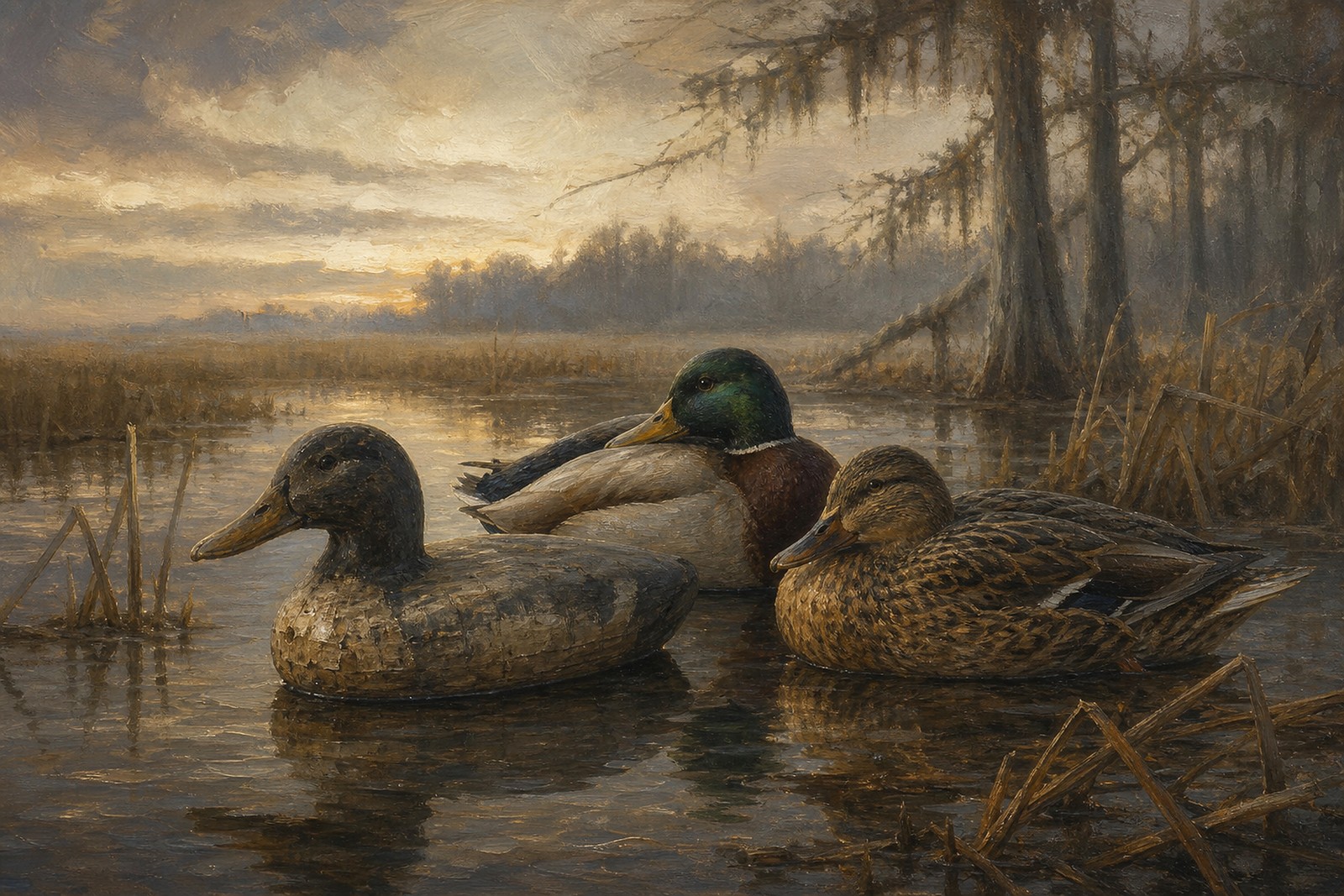
You will never see us describe a print as an antique, a found painting, or a rescued canvas, because it is none of those things, and because the tradition this style borrows from was built by people who were scrupulous about their materials. What the prints borrow is the visual grammar: warm grounds, layered depth, muted working palettes, birds rendered as portrait subjects. Old Decoy and Mallards at Dawn makes the lineage explicit, a weathered working block riding the foreground while live birds cross the dawn behind it, the whole history of the genre in one image, honestly labelled.
Every print is made to order in 3:2 landscape format, edge to edge with no mat, from $59 unframed, $189 framed in black, brown, or gold, or $19 as a digital download, with free shipping to the US, Canada, the UK, Europe, Australia, and New Zealand, dispatch in 2 to 5 business days, and a 30-day replacement or refund for anything damaged, defective, or wrong.
Why does the old look endure?
Because it was never a fashion in the first place. The palette of vintage waterfowl art, umber, dull gold, slate, bottle green, is the palette of an actual marsh at first light, and the marsh has not gone out of style because it was never in it. Trend-driven decor dates itself by chasing the moment; this look was fixed by subject matter and weather, which do not update.
It is also a style rooted in restraint. The working decoy taught it that ornament follows function; the stamp tradition taught it accuracy; and both taught it modesty, low light, quiet colour, nothing straining for attention. Rooms built from those values age the way the decoys did, accumulating character rather than losing currency. There is a reason wetlands and their birds run so deep in folklore and tradition: the imagery predates decorating and will outlast it.
And practically, the look flatters the rooms Americans actually retreat to. Wood, leather, stone, plaid, lamplight: the vintage waterfowl palette was made in the same register, which is why a single print in this style can make a new-build den feel settled.
Building the look at home
Start with one print doing the decoy’s old job: honest, central, unhurried. The classic move is to pair the image with the object, an actual old working decoy, inherited or picked up at a flea market, on the mantel or shelf below the print, so the wall stages the same conversation between tool and art that built the entire genre.
Keep frames in the wood-and-brass family, brown or gold ahead of black, and let wear win: the style forgives worn leather and scuffed floors because it grew up among them. Then, if the wall grows, grow it slowly, a pintail pair, a canvasback, geese in a winter sky, the way a camp accumulates rather than the way a showroom installs. Everything in our lodge and lake house prints is built to hang in exactly that spirit, new work, old school, labelled honestly.
Frequently asked questions
What is vintage waterfowl decor?
A style built on two American traditions: the working duck decoy, which became celebrated folk art, and the Federal Duck Stamp school of waterfowl art, which tied classic bird portraiture to wetland conservation. The look is muted working colours, warm low light, honest materials, and birds treated as serious subjects.
Are your prints actual vintage paintings?
No. They are original AI-created artworks in the style of antique oil painting, and we label them that way everywhere. The style is vintage-inspired; each print is new, made to order, and priced as a print, from $59 unframed and $189 framed.
How do I get the vintage waterfowl look without it becoming a theme?
Restraint. One strong print, frames in brown or gold, and at most one real object, an old decoy or a pair of worn binoculars, staged nearby. The style fails when it is applied like wallpaper and works when the room looks accumulated over years.
Why are old duck decoys so valuable?
Because they are functional sculpture with a biography: hand-carved by identifiable regional makers, painted for work rather than display, and worn by actual seasons on the water. When market gunning ended and hand carving faded, the surviving blocks became finite, and collectors and museums treat the best of them as first-rank American folk art.