If America has a favourite duck to look at, it is not the mallard. It is the wood duck. No other North American duck has been carved, stamped, sketched and collected with anything like the same devotion. Decoy carvers return to it constantly, it has appeared on the federal duck stamp more than once and on state stamps beyond counting, and in any gallery of waterfowl art the drake wood duck is usually the piece people stop in front of first.
The reasons are worth knowing before you buy one, because they explain both what a wood duck print does to a wall and where it belongs. This is the most colour-rich duck on the continent, with a recovery story behind it that gives the image real weight. Get the room right and nothing else in the collection comes close.
Why is the wood duck America’s most collected duck?
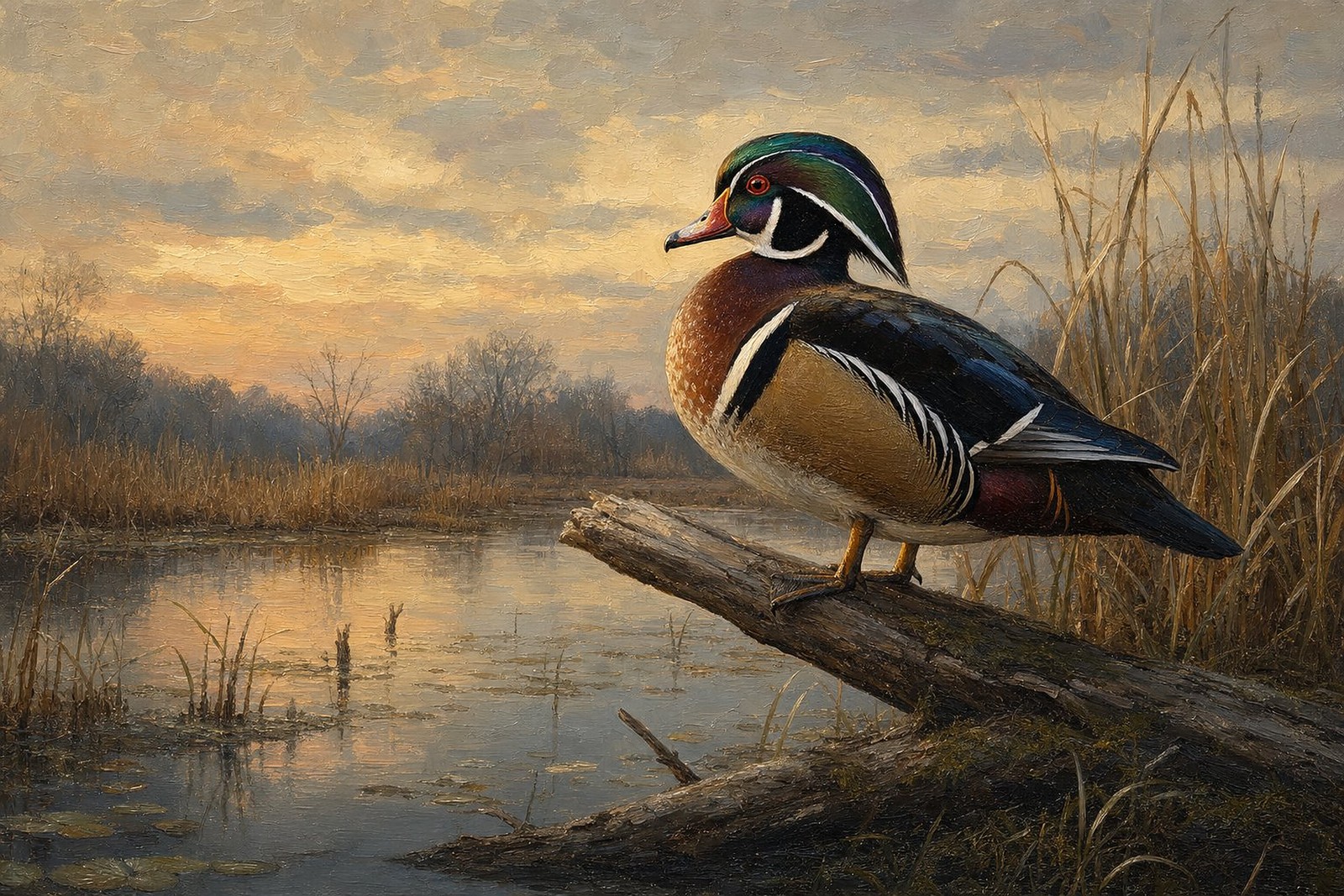
Look at a drake and the question answers itself. The crested head shifts between green and purple depending on the light. The eye is red, the bill parti-coloured, the breast a deep chestnut stippled with white, the flanks a warm buff bounded by crisp white pinstripes. No other duck in North America carries that much pattern, and artists have been drawn to the challenge of it for well over a century.
Carvers rank the wood duck among the most demanding and most rewarding subjects in decoy art. Stamp artists keep returning to it because the plumage reads clearly even at postage size. And collectors of waterfowl prints tend to acquire one early, because a wall of ducks without a wood duck feels like a deck missing its face card.
There is also the story. Collectors do not only collect images. They collect meaning, and the wood duck carries more of it than any duck we sell.
The duck America nearly lost
By the early 1900s the wood duck was close to gone. Unregulated market hunting took a heavy toll, and the clearing of old bottomland forests removed the tree cavities it nests in. Writers of the day openly doubted the species would survive.
Then came one of conservation’s first great recoveries. The Migratory Bird Treaty Act of 1918 ended the market gunning, closed seasons gave the population room to breathe, and from the 1930s onward thousands of nest boxes went up along wooded waterways to replace the lost cavities. The birds answered. Today wood ducks are once again a common sight on quiet, tree-lined water across the eastern United States.
That history is part of what a wood duck print puts on the wall: a small, handsome monument to the idea that things can be brought back. It is a reason this species suits a study or a family lake house so well. It gives the room something true to say.
Where does a colour-rich print work best?
A wood duck print needs slightly more thought than a mallard, precisely because it carries more colour. Rendered in antique oil-painting style, the iridescence settles into deep, lacquered heritage tones rather than anything garish, but it is still the boldest image in the collection, and bold images do their best work against quiet backgrounds.
The natural homes are rooms with deep, settled palettes: a study with green or navy walls, a dining room with dark timber, a hallway that needs one deliberate moment of colour. It is also a natural fit for the layered, pattern-friendly rooms covered in our guide to grandmillennial bird prints, where a colour-dense bird holds its own amid chintz and cane. The one place to hesitate is a wall already busy with pattern and ornament, where the drake’s plumage has to shout for attention. Give it calm surroundings and it carries the room alone.
Our wood duck drake on a fallen branch
Wood ducks are true perching ducks, with clawed toes that let them sit comfortably on deadfall and branches, and they nest in tree hollows above the water of wooded ponds and sloughs, the quiet corners of the pond and pothole country. Our print honours that habit: the drake stands on a fallen branch over dark, still water, the full pattern of the plumage caught in soft side light.
It is an original AI-created image in the style of classic American sporting art, composed as a 3:2 landscape and printed edge to edge, with no mats and no borders. Sizes run 12x18 at $59, 16x24 at $89 and 20x30 at $119 unframed, or $189, $259 and $329 framed in black, brown or gold. A digital download is $19. Every print is made to order, dispatched in 2 to 5 business days, and ships free to the US, Canada, the UK, Europe, Australia and New Zealand.
How should you frame the most colourful duck?
Gold is the traditional answer, and it remains the best one for formal rooms: it picks up the buff flanks and the warm chestnut breast and gives the image the clubby, collected look wood duck art has carried for generations. Brown timber calms the image further and suits cabins and dens. Black is the modern option, sharpening the colour by contrast, and works where the furniture runs cleaner and newer.
If the print will hang among others, match the frame colour across the group. The wood duck can differ from its neighbours in subject and intensity, but the framing should hold the wall together.
Pairing the wood duck with quieter species
One loud print per wall is a sound rule, and the wood duck is the loud print. It pairs beautifully with the quieter species around it: a mallard in dawn light, a goldeneye on cold water, a wigeon pair on a still pond. Because the rest of the duck prints in The Print Room are rendered in the same light and the same oil-painting-style treatment, the group reads as one collection rather than an assortment, with the wood duck as its natural centrepiece.
On a three-print wall, hang the wood duck in the middle. In a pair, let it take the side nearer the room’s entry, where the colour greets the eye first, with the calmer species completing the arrangement.
Frequently asked questions
Is the wood duck really America’s most collected duck?
Across the collecting traditions that matter, decoy carving, duck stamps and waterfowl prints, the wood duck appears with remarkable persistence, and among carvers in particular it is a perennial favourite. The mallard is the more common bird. The wood duck is the more collected image, which is exactly the distinction that matters on a wall.
Is this print a reproduction of a stamp or an old illustration?
No. It is an original AI-created image in antique oil-painting style, made for this collection. It sits in the visual tradition of American stamp and sporting art, but it is not a copy of any historical work, and we always describe it exactly as it is.
What room suits a wood duck print best?
A study, dining room or hallway with a deep, quiet palette: green, navy, dark timber. The print supplies the colour, so the room should supply the calm. It is the piece we recommend when a wall needs one deliberate moment of richness.
How quickly will it arrive, and what if something goes wrong?
Each print is made to order and dispatched in 2 to 5 business days, with free shipping to the US, Canada, the UK, Europe, Australia and New Zealand. Anything that arrives damaged, defective or wrong is replaced free or refunded within 30 days. We do not take change-of-mind returns, so check your sizes against the wall first.